
 What's on
 Things to Do
 Plan your Visit
 Media Rules and Filming

𝐓𝐇𝐄 𝐒𝐄𝐍𝐀𝐓𝐄 𝐃𝐄𝐌𝐀𝐍𝐃𝐒 𝐂𝐋𝐄𝐀𝐑 𝐀𝐍𝐒𝐖𝐄𝐑𝐒 𝐎𝐍 𝐃𝐑𝐎𝐔𝐆𝐇𝐓 𝐑𝐄𝐒𝐏𝐎𝐍𝐒𝐄


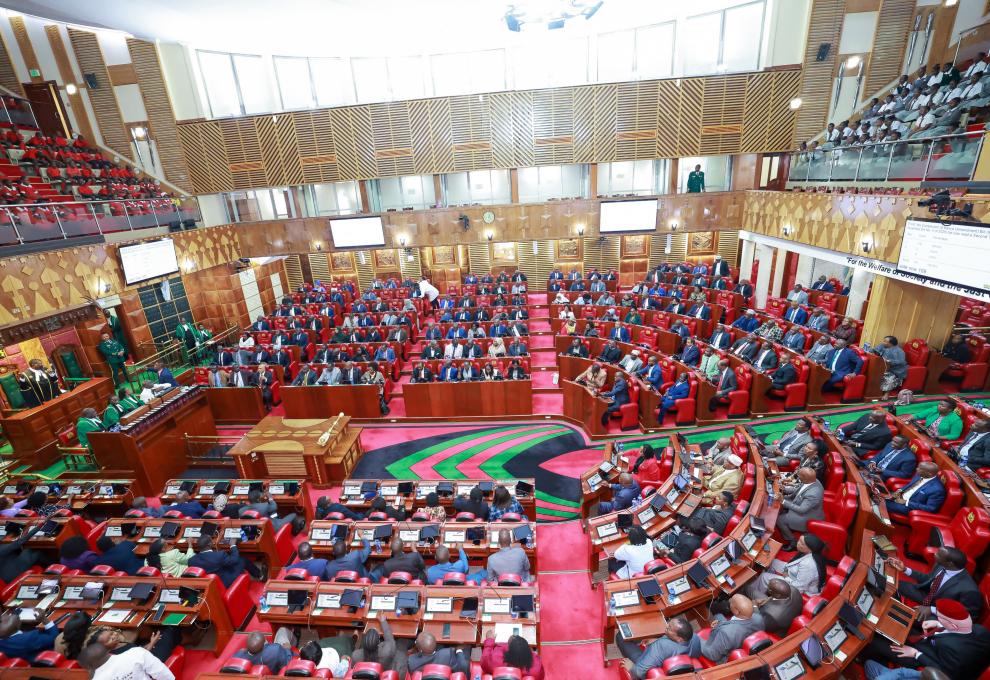
The Senate has firmly questioned the adequacy and accuracy of the Government’s response to the worsening drought situation across Kenya’s arid and semi arid lands (ASAL), directing the Cabinet Secretary to return to the House with clear and more comprehensive data.
Appearing before the Senate Plenary on Wednesday, the Cabinet Secretary for East African Community Affairs, the ASALs and Regional Development, Beatrice Askul told Senators that the Government remained committed to protecting the lives and livelihoods of Kenyans affected by prolonged drought conditions.
She assured the House that national authorities were working closely with county governments, development partners and humanitarian agencies to ensure that drought response efforts remain coordinated and responsive to the evolving humanitarian situation.
Responding to a question by Senator Enoch Wambua (Kitui), the Cabinet Secretary acknowledged that the prevailing drought has had severe consequences for vulnerable communities across affected regions.
According to the CS, drought conditions have intensified hardship through acute shortages of water for both domestic and productive use, rising food and nutrition insecurity and a steady decline in livestock and crop production systems that rely heavily on rainfall.
“The current response measures are designed to cushion affected communities, protect lives and safeguard core livelihood assets. These interventions are primarily relief oriented and focus on enhancing household coping capacity, minimising asset depletion and preventing irreversible losses,” stated the CS.
She explained that the Ministry, through the National Drought Management Authority (NDMA) is implementing a series of drought response interventions funded under the National Drought Emergency Fund and with support from the European Union.
The interventions are supported by a budget allocation of Ksh 265,718,782.90.
According to the Cabinet Secretary, the programme has prioritised critical water related interventions, including water trucking to drought stricken areas, fuel subsidies for water supply systems, repair of strategic water facilities, provision of water storage tanks and distribution of livestock feed to protect pastoral livelihoods.
In addition, she informed Senators that the Ministry had disbursed unconditional cash transfers to 133,800 poor and vulnerable households across eight arid counties.
The counties benefiting from the programme include Turkana, Marsabit, Wajir, Mandera, Garissa, Isiolo, Samburu and Tana River.
The support is delivered through the Hunger Safety Net Programme (HSNP), which is one of the flagship initiatives under Kenya’s long term development blueprint, Vision 2030.
The monthly stipends, the CS explained enable beneficiary households to purchase food and meet other essential household needs at a time when drought conditions have significantly undermined traditional livelihoods.
CS Askul further revealed that out of the Ksh 4.1 billion allocated by the National Government for drought response, the NDMA had received Ksh 350 million to support critical water sector interventions, repair and maintenance of strategic boreholes, food security assessments and coordination of drought response activities.
However, the Senate expressed serious concerns about the adequacy of the information presented to the House.
According to the Cabinet Secretary, the current drought phase classification still indicates significant stress across ASAL counties despite the occurrence of off season rains.
Four counties Mandera, Kilifi, Kwale and Wajir remain in the Alarm phase, signalling heightened drought stress and the need for sustained emergency interventions.
Meanwhile, 13 counties including Samburu, Baringo, Marsabit, Kitui, Taita Taveta, Kajiado, West Pokot, Garissa, Isiolo, Tana River, Turkana, Lamu and Tharaka Nithi are classified in the Alert phase reflecting persistent drought pressure and the need for continued monitoring and response measures.
Laikipia and Narok counties are categorised under the Pre Alert phase, while Makueni, Nyeri, Embu and Meru remain in the Normal phase with environmental indicators largely within seasonal ranges.
Despite these interventions, the Cabinet Secretary acknowledged that food insecurity remains widespread.
As of February 2026, an estimated 3.3 million people across the 23 ASAL counties are faced with lack of food. The situation is expected to deteriorate further in the coming months according to the report by the CS.
Projections indicate that the number of food insecure people could rise to approximately 3.68 million by June 2026, a significant increase within a four month period.
“Nine counties, including Mandera, Turkana, Marsabit, Wajir, Isiolo, Garissa, Tana River, Samburu and Kwale are currently experiencing serious food insecurity where many households are unable to meet their basic food needs without external assistance,” submitted CS Askul.
However, during the supplementary questions segment, Senators strongly challenged the accuracy and sufficiency of the information provided by the Ministry.
Several lawmakers expressed dissatisfaction with the data presented, arguing that it did not adequately reflect the realities on the ground or provide clear answers to the concerns raised in the initial question.
The Senators insisted that the information provided to the House must be accurate, comprehensive and capable of guiding effective policy interventions in the face of a growing humanitarian crisis.
They urged the Speaker to direct the Cabinet Secretary to return with more reliable data and clear responses.
Responding to the concerns raised by the lawmakers, Senate Speaker Amason Kingi ruled that the answers presented to the House were not satisfactory.
He directed the Cabinet Secretary to go back and prepare more detailed and accurate responses before appearing again before the Senate.
“CS, listening to the concerns raised by the Hounourable Senators clearly, your responses to their questions remain unsatisfactory and therefore the Senate will communicate a date when you will come back to this plenary for purposes of giving satisfactory responses to all the concerns that have been raised,” ruled Speaker Kingi.